Door of the Mind
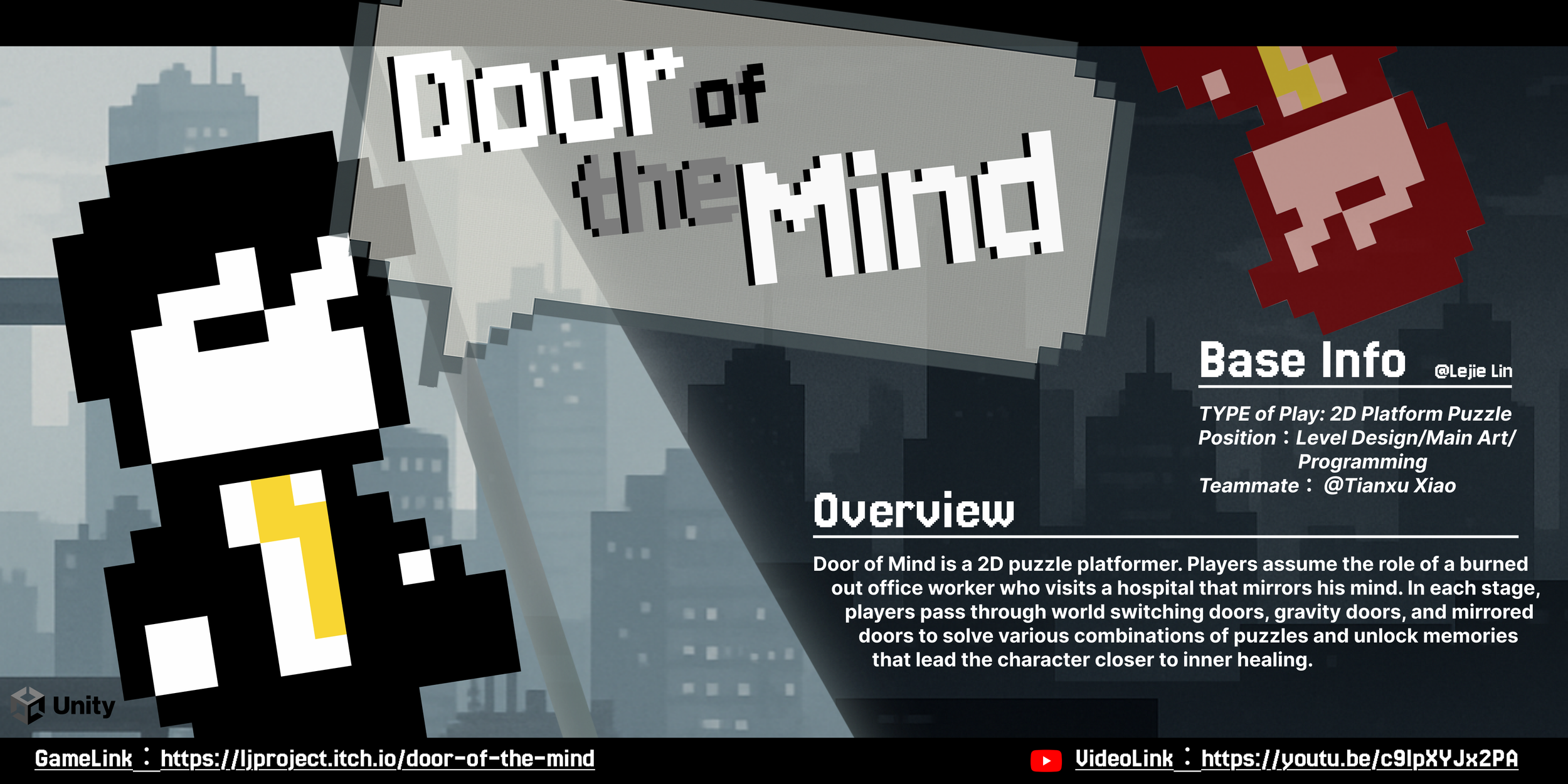
Door of the Mind is a 2D puzzle platformer. Players assume the role of a burned-out office worker who visits a hospital that mirrors his mind. Each level turns inner struggles into spatial puzzles solved through world-switching, gravity, and mirror doors. The player’s goal is to navigate through doors, activate buttons, and collect keys to uncover buried memories that bring the character closer to inner healing. Through this game, I hope players can reflect on the fatigue of modern work life. By translating these emotions into puzzles, I aim to invite players to find quiet joy in those “aha” moments when playing. The experience is meant to be a quiet meditation. As the story reaches its end, the protagonist rediscovers himself, and I hope players do too.
INTRODUCTION
Trailer & Gameplay Highlights
My Role & Contributions
This project was developed during a remote game design workshop instructed by Professor David. In this project, I:
Led programming and implemented core gameplay systems
Design Level 3 and polished Levels 1-2, including the mirror door mechanic.
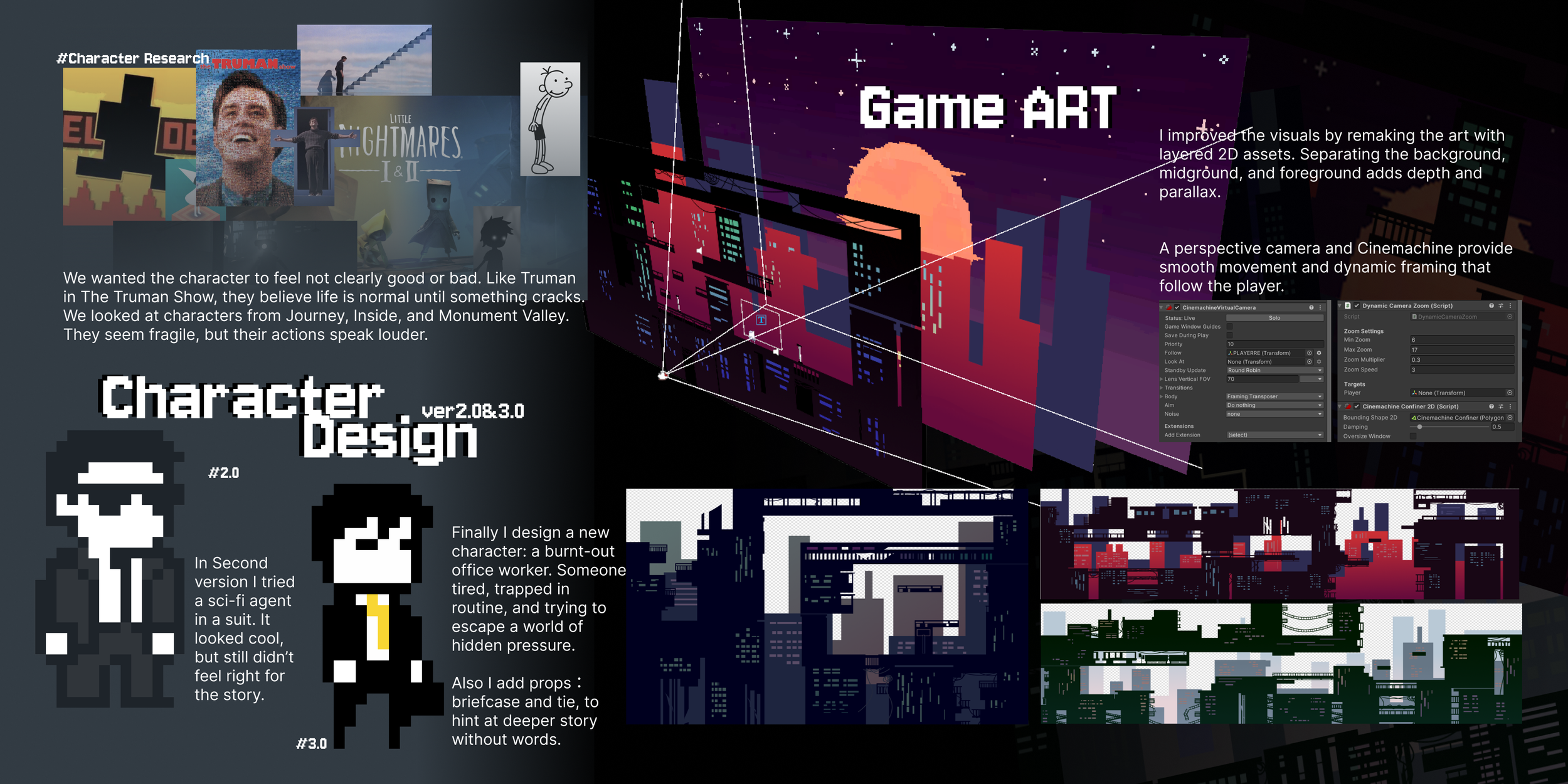
Created character art, UI, motion graphics, and edited the trailer.
Managed version control using GitHub
Collaborated with Tianxu Xiao, who designed Level 1-2 and the gravity/world switch door mechanics.



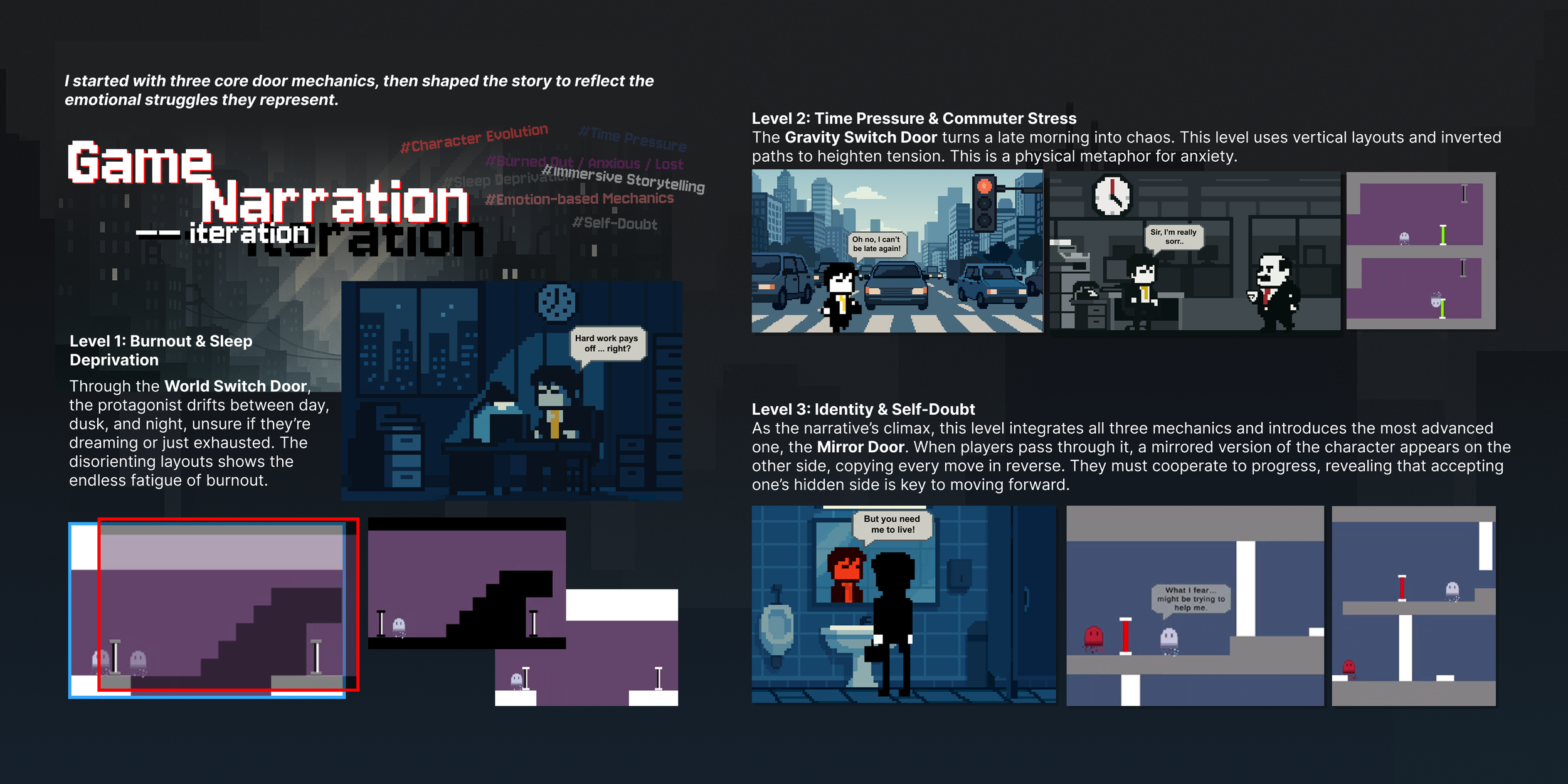
The Three Door Mechanics
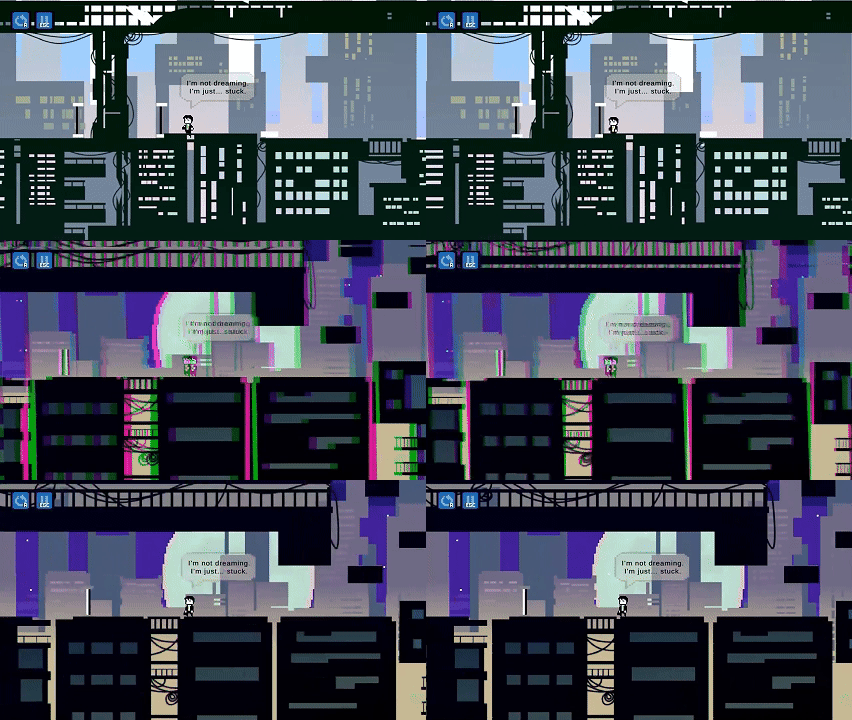
World Switch Door
Toggles day, night, and dusk as the environment shift with new layouts and obstacles.
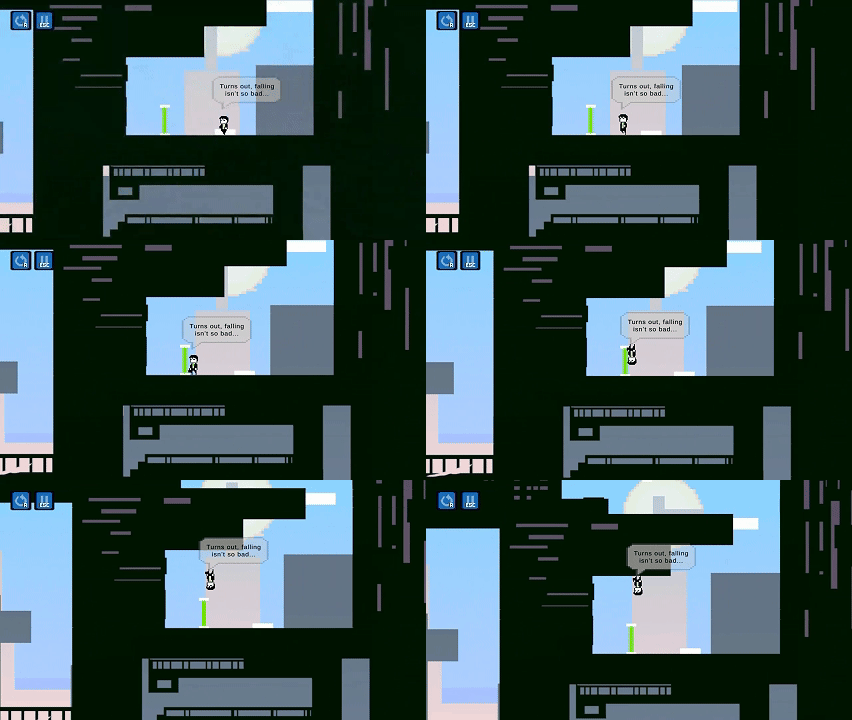
Gravity Door
Reverses gravity to access unreachable switches
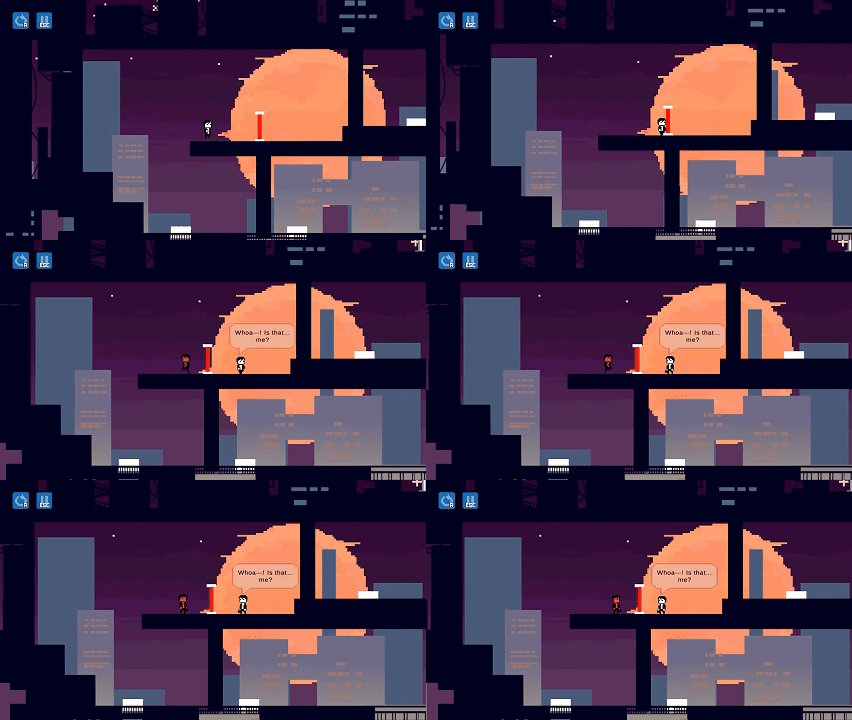
Mirror Door
Creates a mirrored self that moves in reverse to help solve puzzles.
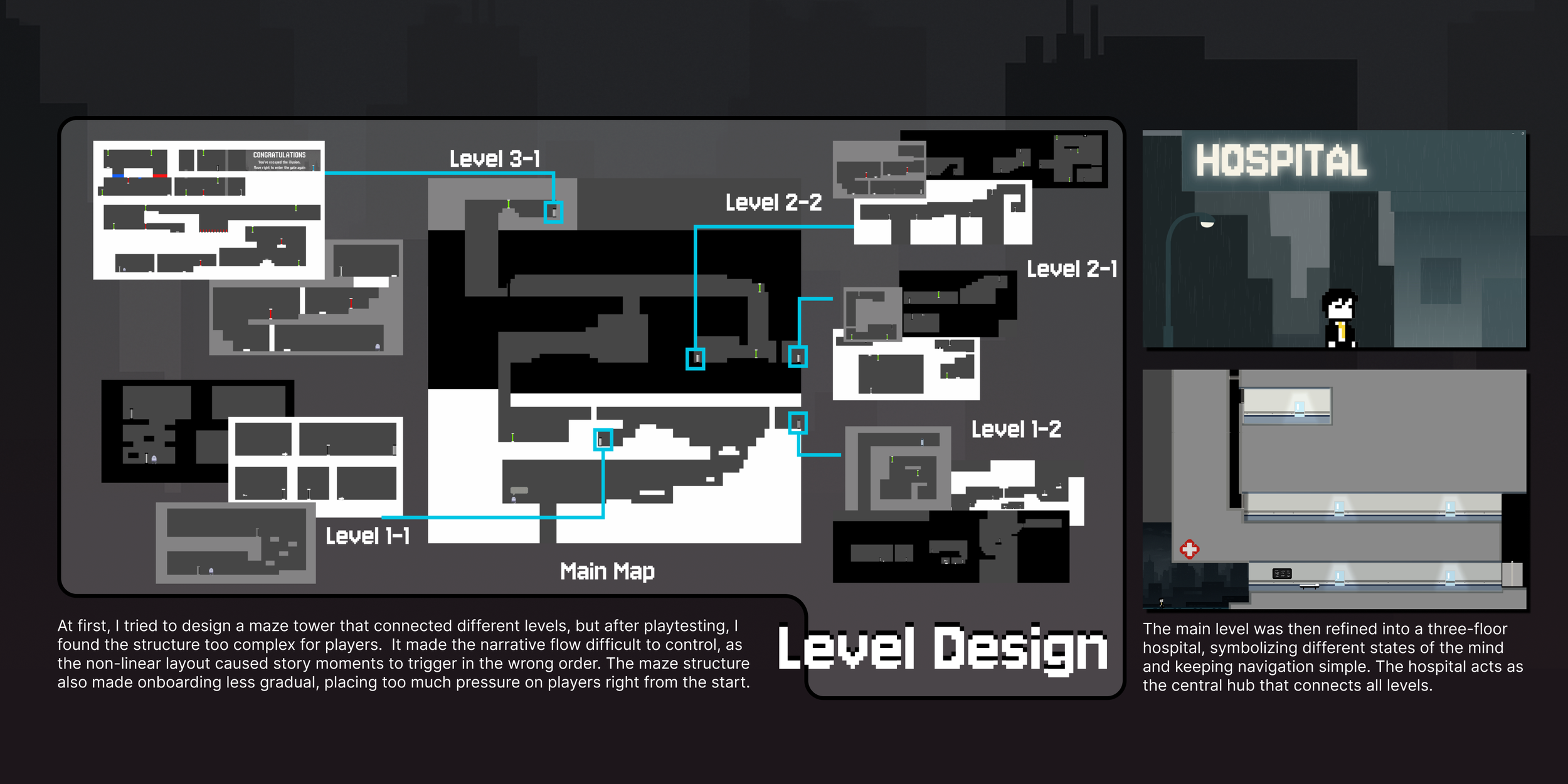
Level Design Highlights
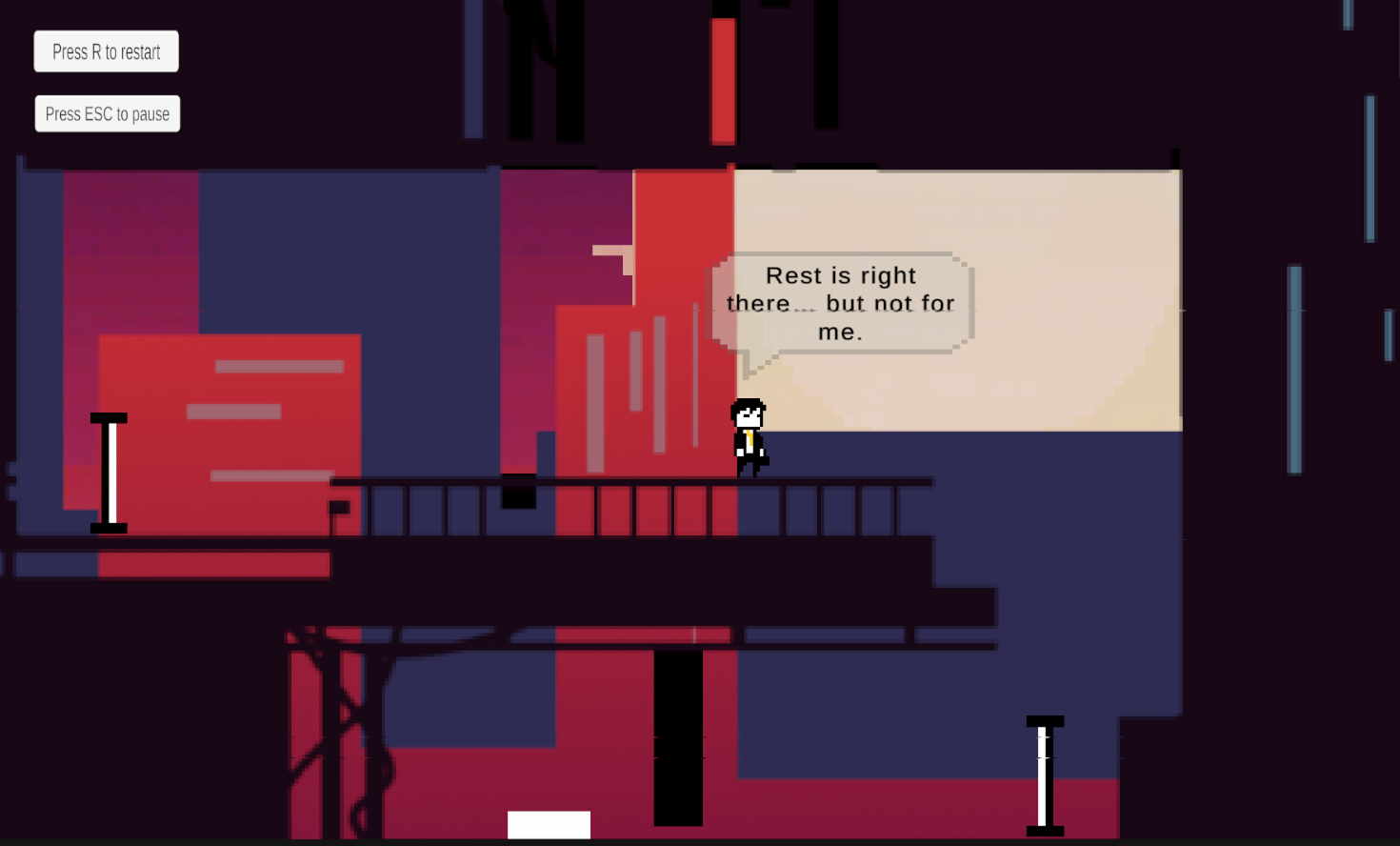
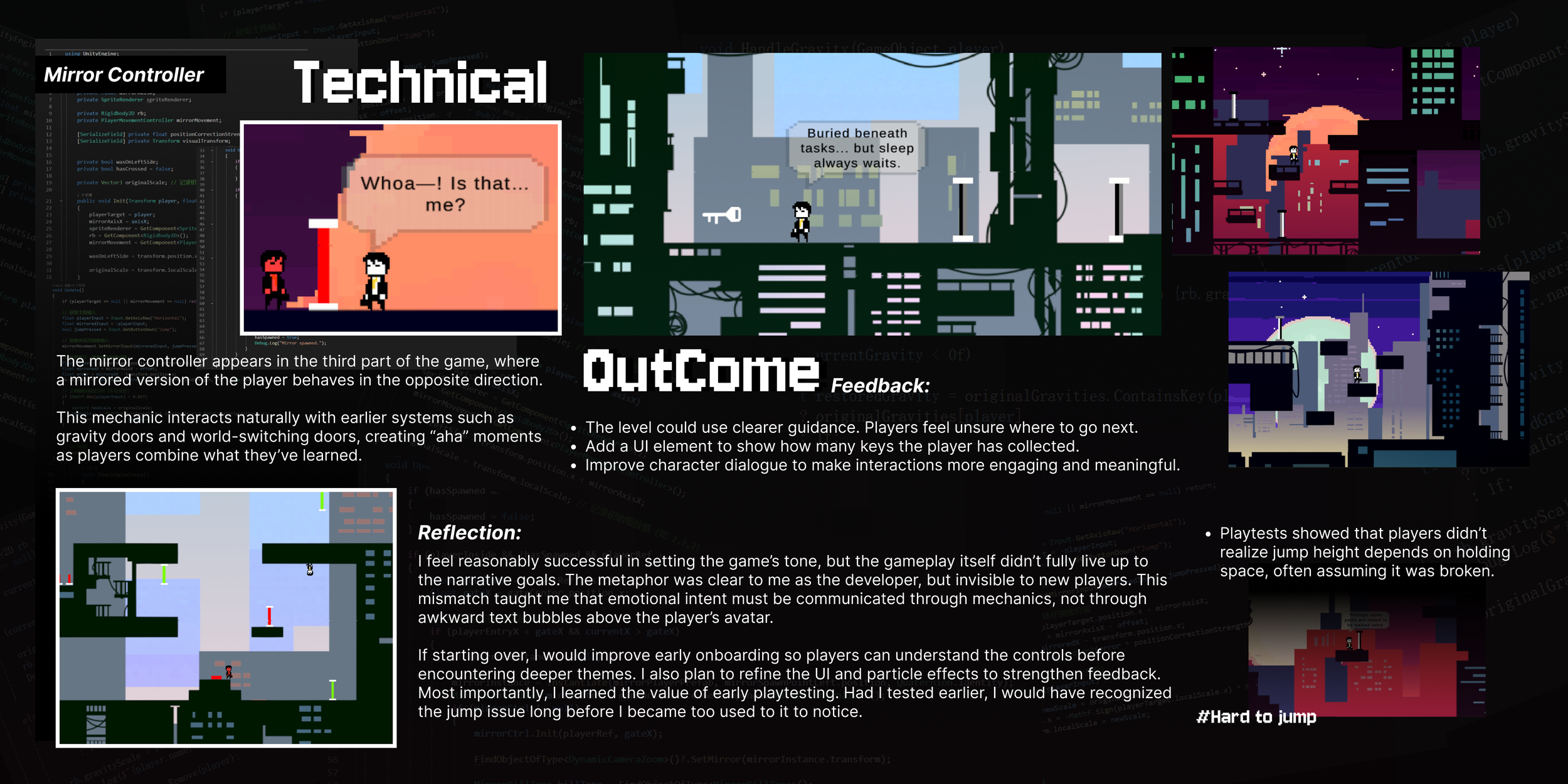
This level features a dual world switching puzzle. In the night world, a gate blocks a button, so the player switch to the day world where the gate doesn’t exist. It reflects how burnout traps people in the same loop and requires address the problem at its source.
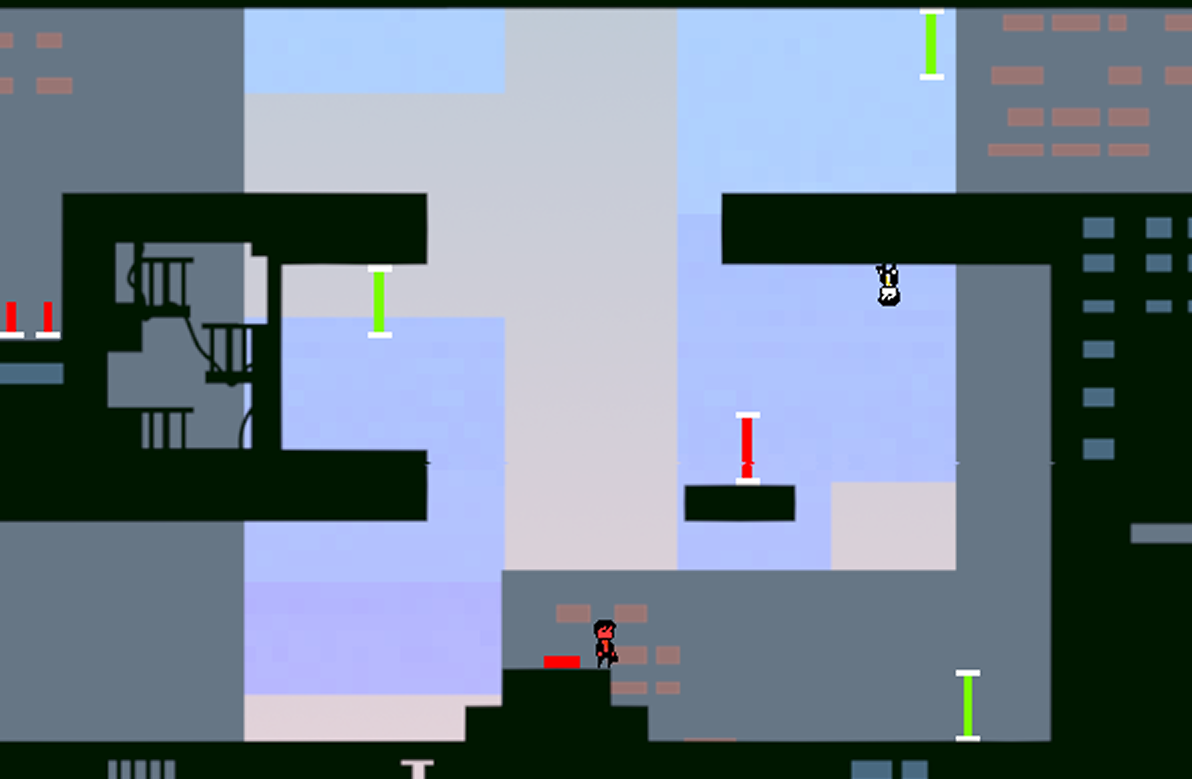
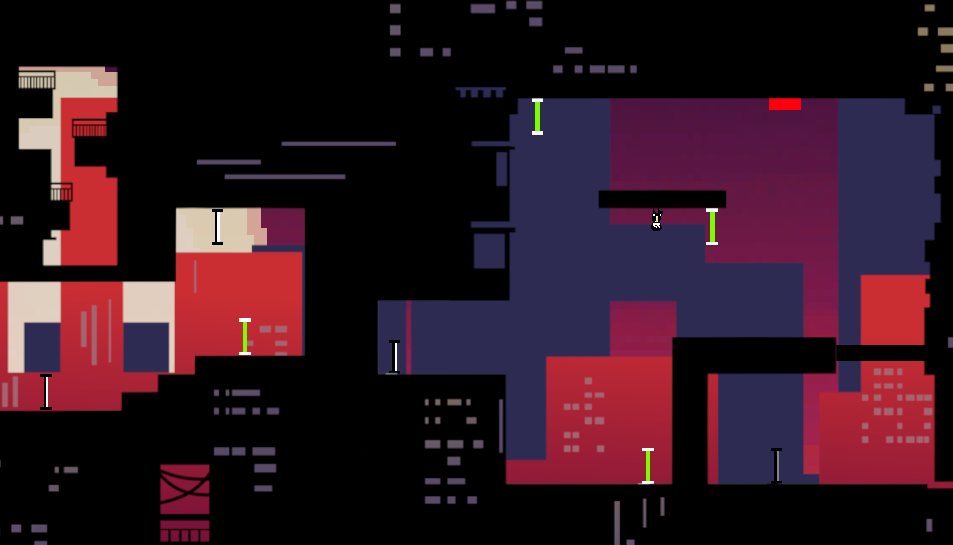
This level combines the gravity door and mirror door, challenging players to navigate flipped space. It forms a layered puzzle that highlights how shifting perspective is key to moving forward.
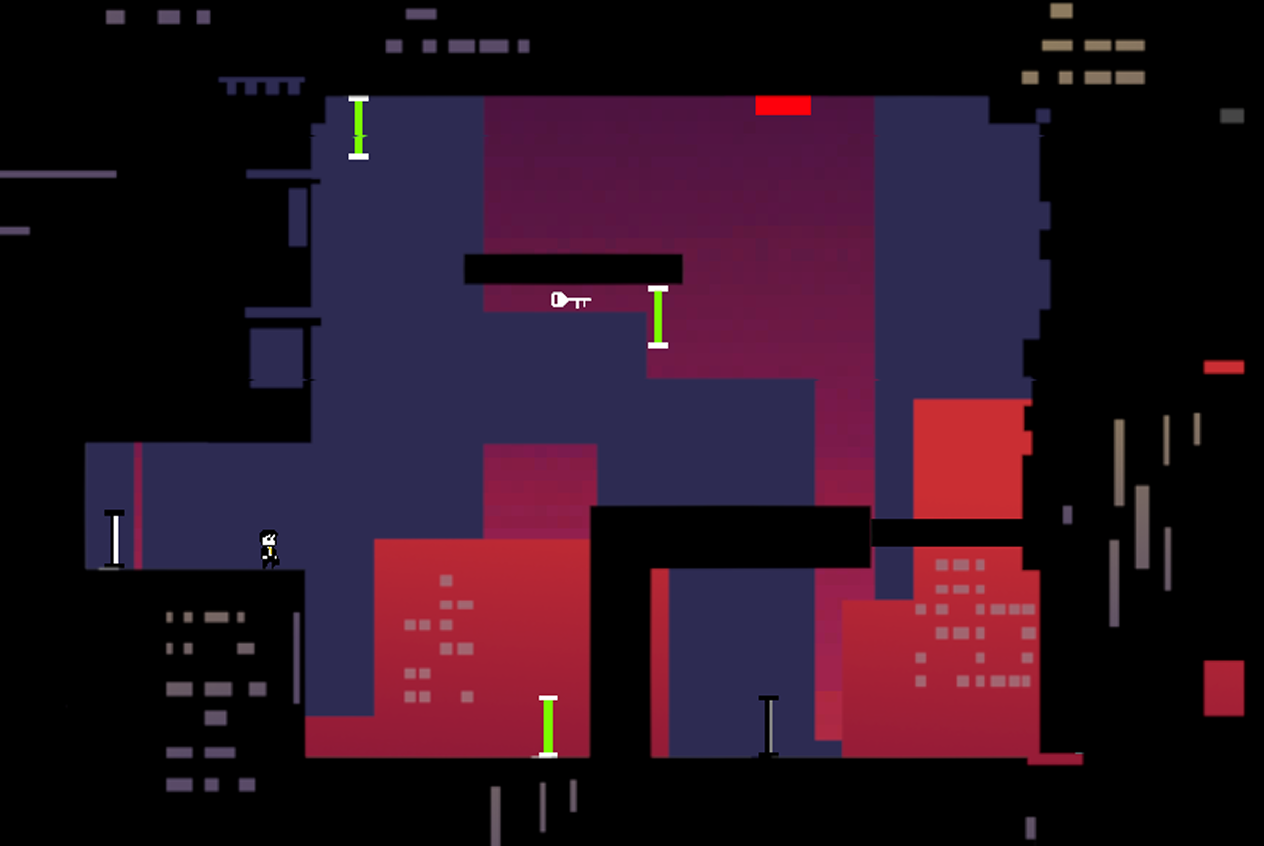
This door hub challenges players to master the gravity mechanic through button-based puzzles, while subtly reflecting the protagonist’s dizziness and pressure caused by the earlier day and night changes.
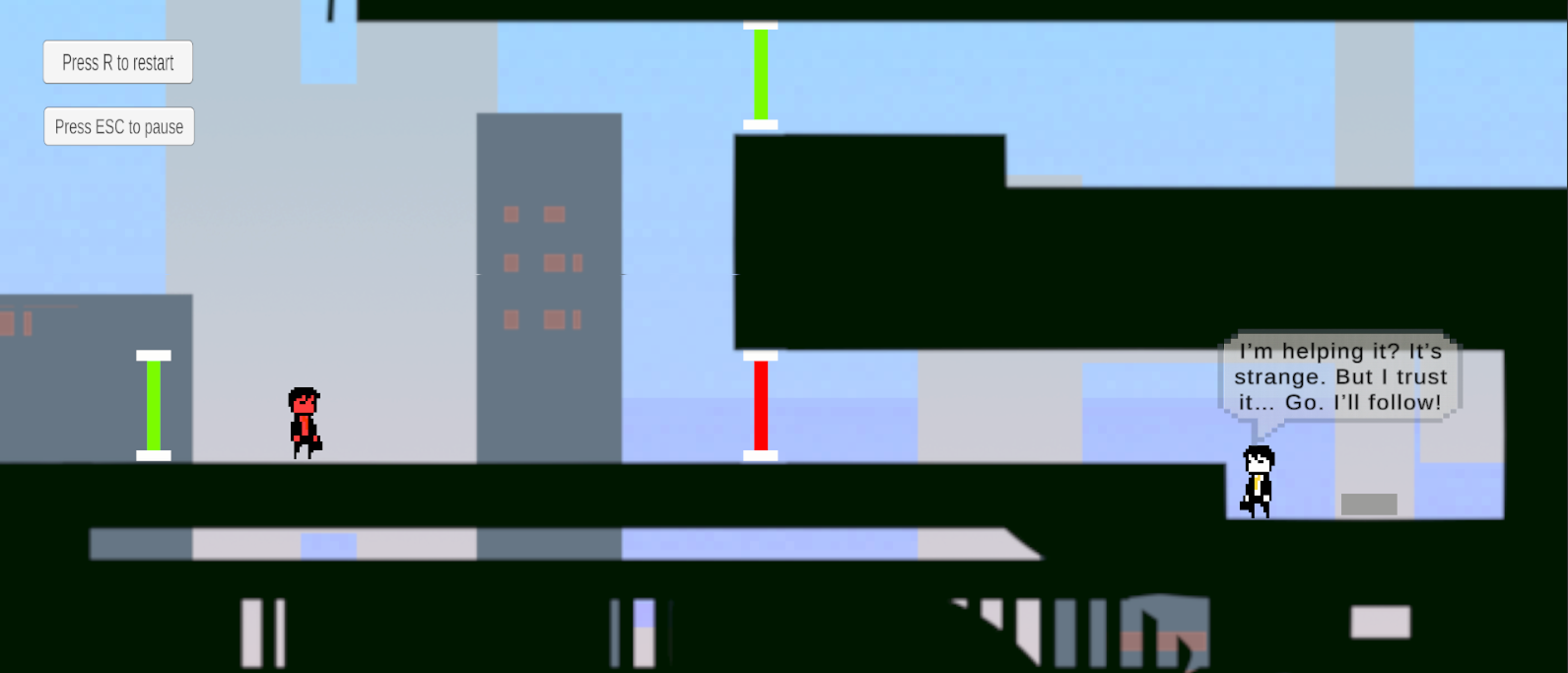
This level challenges the usual logic. Player must press buttons to help the mirrored self, showing that supporting one’s inner feelings is the path to peace.
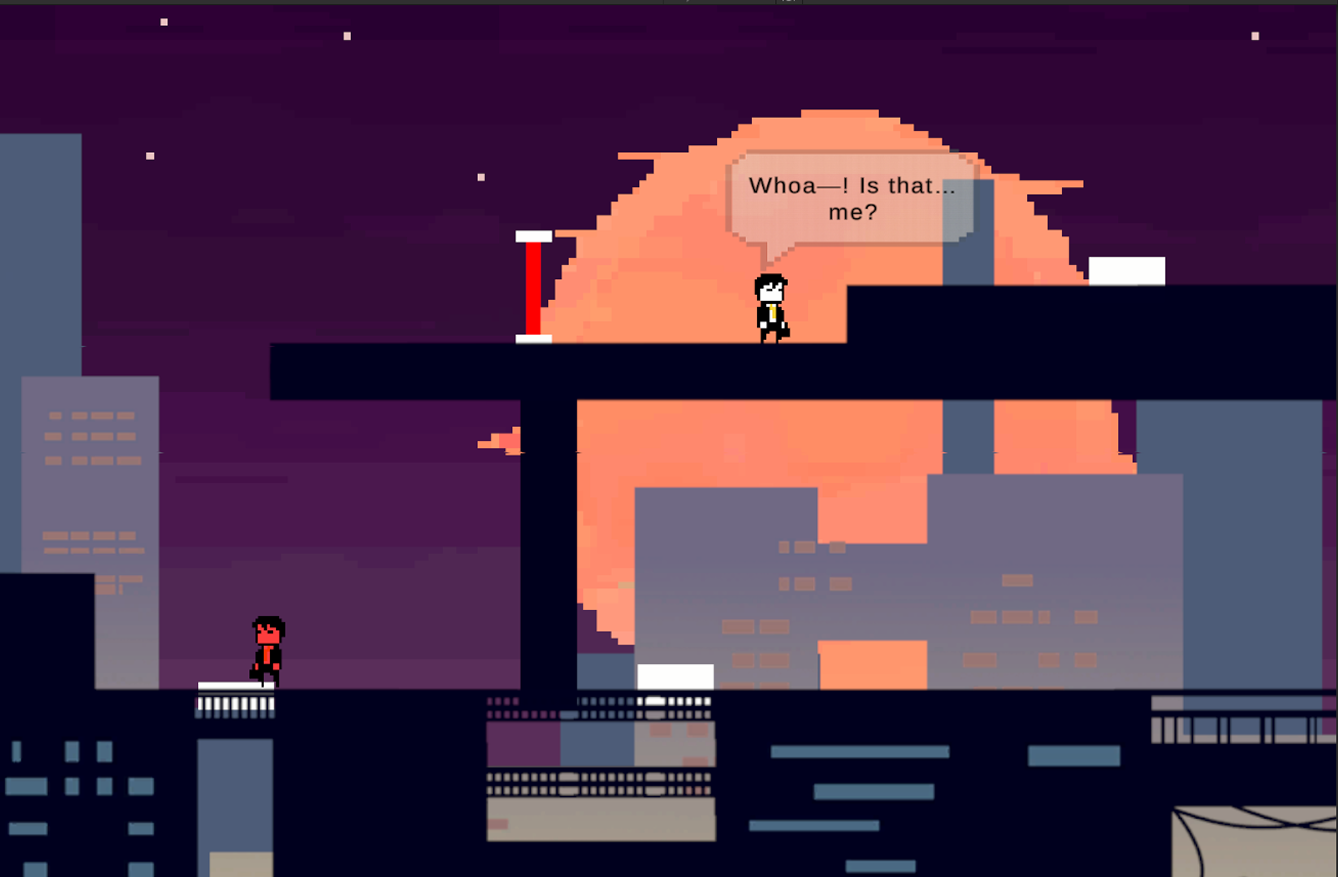
This level introduces the mirror door. Pasing through it creates a mirrored version that moves in reverse. It tests the player’s ability to coordinate with this double to open the path, and symbolizes how facing the self they’ve been avoiding becomes the way out.
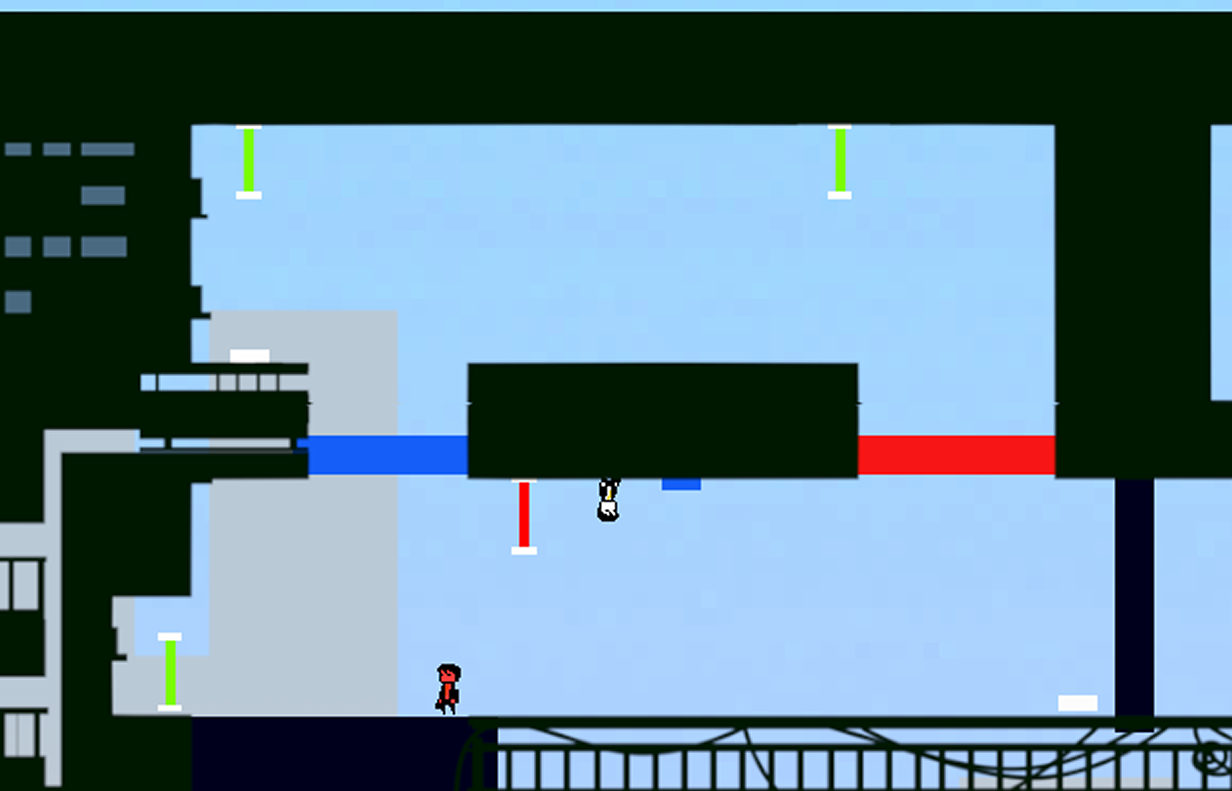
At the climax, this level combines all previous mechanics and pushes spatial reasoning to its peak. When the protagonist finally finds the way out, the mirrored self fades and reaches harmony.
Playtest & Feedback
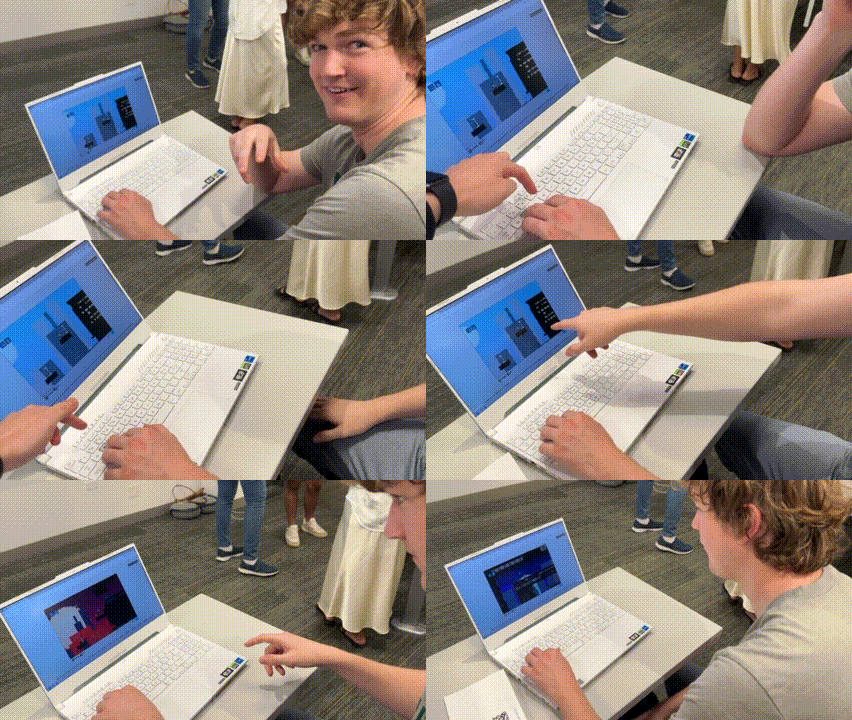
Players needed guidance to understand the jump and world-switching mechanics, showing the onboarding could be clearer.
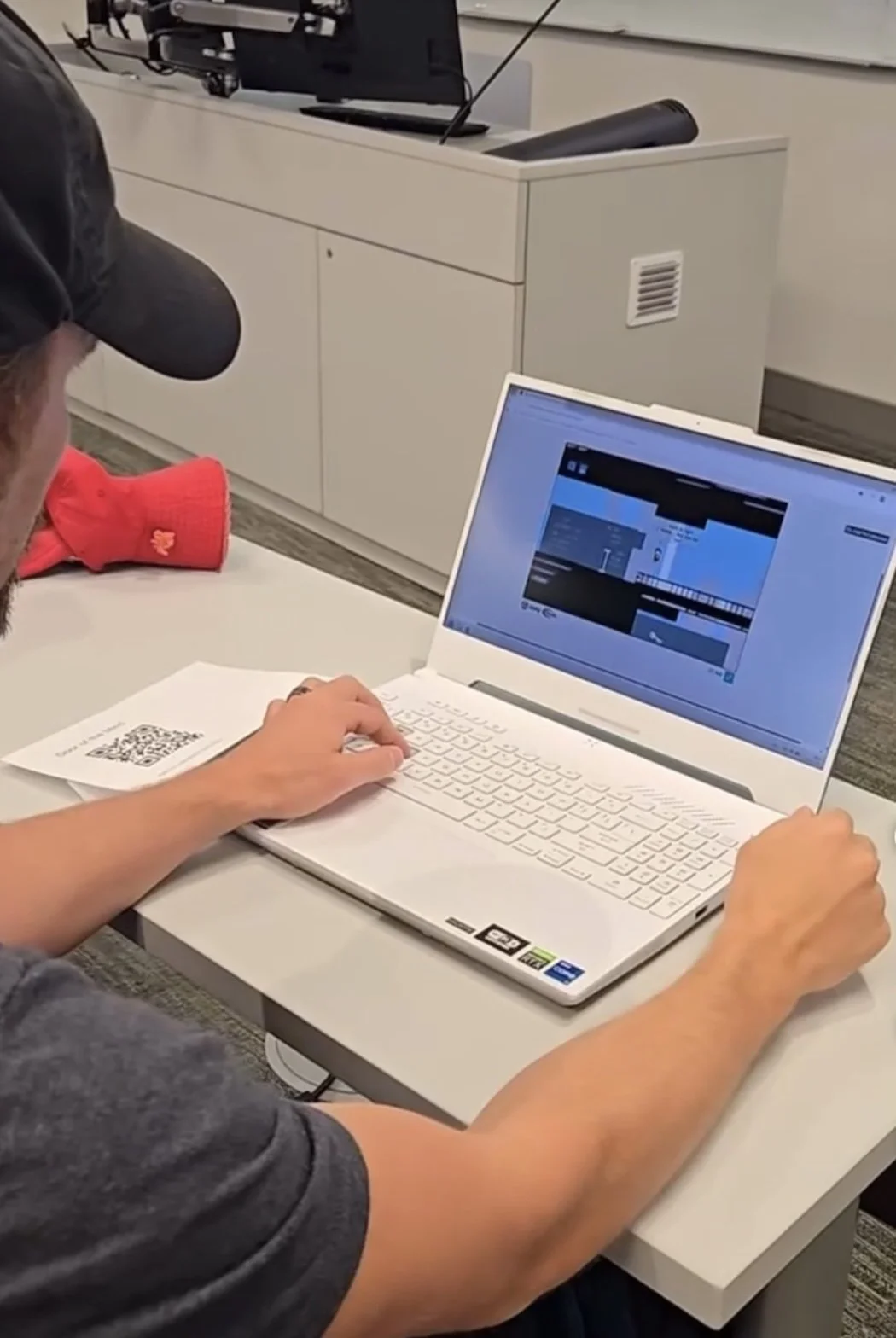
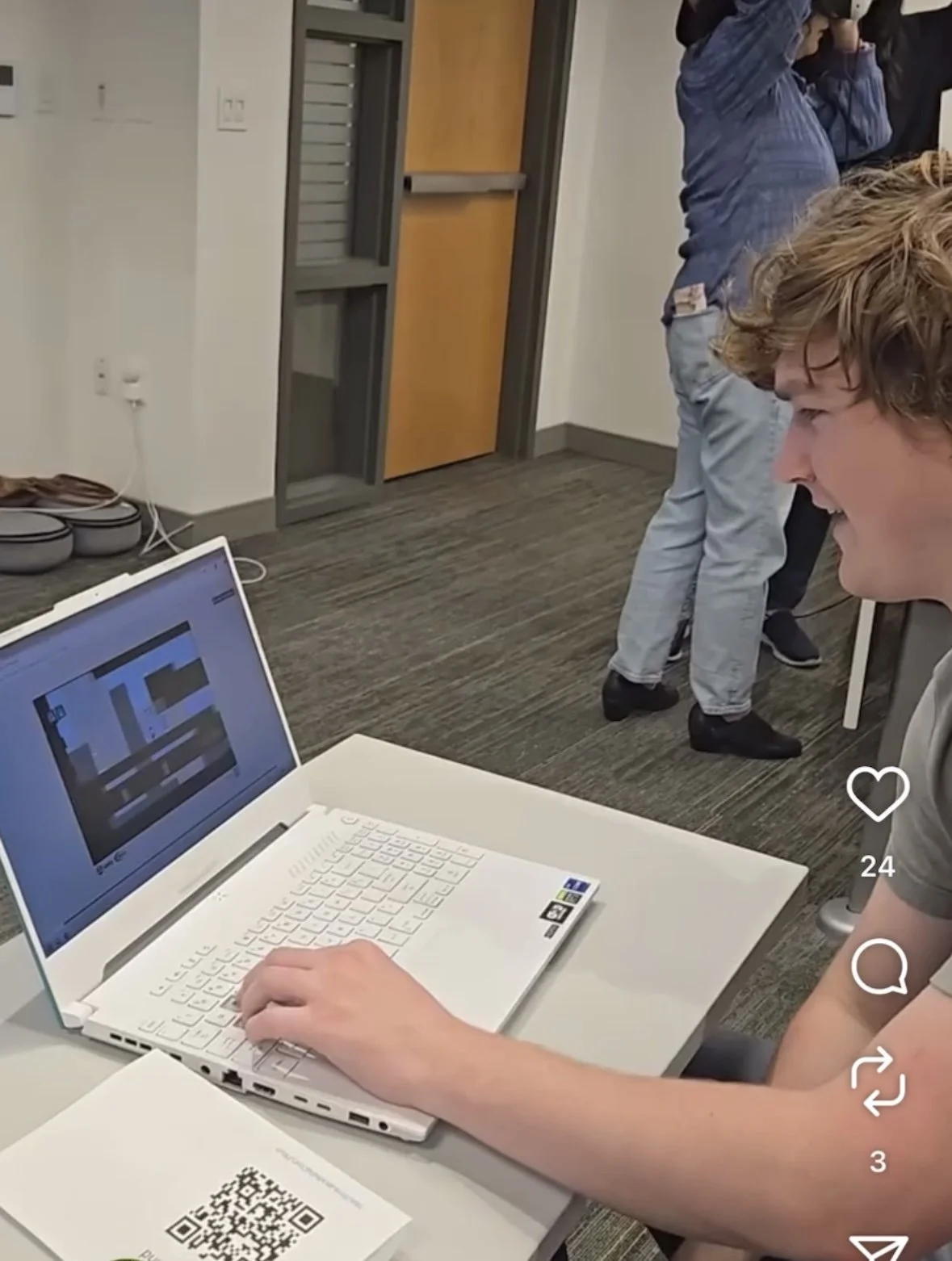
I took part in a playtest organized by the school and received a lot of feedback. One of the students commented as follows:
"I LOVED the graphics and look of it. You could tell they worked really hard on it. It is super simplistic and easy to play and I had a lot of fun playing it. My only suggestion is that you stay in the air for the tiniest bit longer. But other than that I loved it."
What Worked
Players experienced genuine “aha” moments as they combined learned mechanics.
The overall tone resonated well with players.
Issues Identified
Metaphor clarity: Players did not fully grasp the metaphor; gameplay didn’t consistently support the intended narrative goals.
Unclear objectives: Collecting multiple keys was not clearly communicated at the start. Players frequently felt unsure where to go next.
Jump mechanic confusion: Players didn’t realize jump height depended on holding the space bar, often assuming it was broken.
World-switching logic:
Some players questioned why day/night changes would alter map structure, finding it logically inconsistent.
One suggestion: reframe it as past / present / future.
My intention: keep the day–night shift to express burnout, social pressure, dizziness, and illusion—the world doesn’t literally change; the shifting structure symbolizes internal obstacles.
Unexpected inspirations:
Some players asked whether the game drew from Every Day the Same Dream or VVVVVV.
Although I hadn’t played them, later research revealed surprising parallels, which showed both the unique aspects of my design and the need for deeper thematic research in future iterations.
Development Details